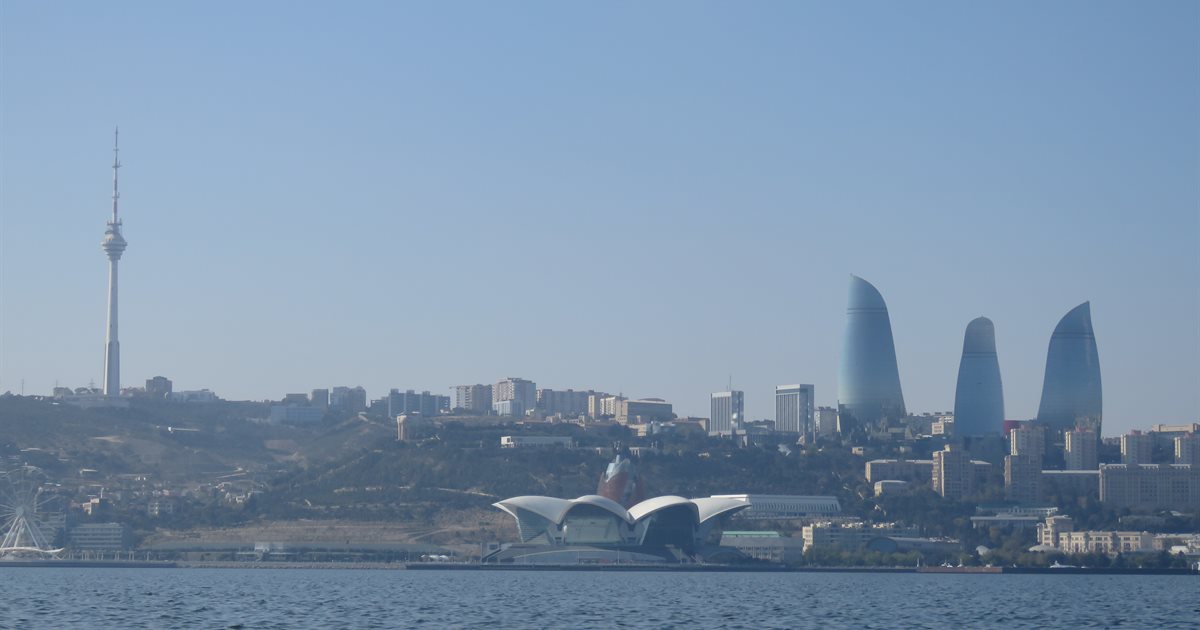
The Caspian is an unusual sea. By size it is the largest enclosed body of water on the planet, by water composition a brackish lake, and by its fauna a mix of marine and freshwater species. Fishing from the deck of a yacht in Baku Bay is not a "guaranteed catch" — it is more a quiet way to spend a few hours on the water, land a couple of local species and be alone with the sea. In this guide — what actually lives here, when it is best to go out, what tackle to bring and what you need to know in advance.
What lives in Baku Bay
In the coastal waters near Baku you will most often come across:
- Caspian goby — the most characteristic fish of these waters. Small (15-25 cm) but active, it bites all year round, including from a yacht at anchor.
- Mullet — a schooling fish, taken on a spinning rod and a float rod, especially near piers and rocky stretches.
- Kutum (Caspian white fish) — a traditional Caspian fish, prized for its taste. In Azerbaijan it is baked whole — a national dish. A seasonal species, more active in spring and autumn.
- Wild carp and catfish — less common, mostly around the deltas of the rivers flowing into the Caspian. In Baku Bay itself they are hard to catch, but it is possible.
- Sand smelt — a small schooling fish, takes light tackle, often in numbers.
These are fish for recreational angling. If you want a large commercial catch, you need to go to the delta or to specialised spots, not to Baku Bay.
What is protected — sturgeon may not be caught
This is the first thing any honest operator should tell you:
All Caspian sturgeon species — sturgeon, beluga, stellate sturgeon, ship sturgeon — are protected and banned from both commercial and recreational fishing. Azerbaijan has a moratorium on sturgeon fishing, and a violation carries criminal liability.
If an operator promises to "catch a sturgeon" or to "try black caviar from a fresh catch", that is a serious warning sign: either they do not know the law, or they are inviting you to take part in poaching. Neither is acceptable.
If a sturgeon does end up on the hook by accident, it must be carefully released back into the water. That is simply how a law-abiding angler behaves on the Caspian.
More on how to tell an honest operator from a fraudster — in the article "How not to lose money when renting a yacht in Baku".
🚫 Spawning ban: 1 May – 30 June
From 1 May to 30 June, recreational and sport fishing on the Caspian is prohibited in Azerbaijan. This is the spawning period for most species — the ban covers the entire Caspian Sea within Azerbaijani waters, the rivers flowing into the Caspian and the canals connected to it.
The source is an official announcement by AZERTAC, the state news agency of Azerbaijan. The ban applies every year.
In addition: from 1 May to 1 September an extended moratorium on fishing applies to inland waters (the Kura and Sarysu rivers, the Mingachevir, Shamkir, Araz and Yenikend reservoirs) — but this concerns inland waters, not the Caspian.
What this means in practice:
- In May and June you can still go out on a yacht in Baku Bay, but not for the purpose of fishing — a sightseeing cruise, swimming and photo shoots remain legal
- If an operator offers you "May fishing" in Baku, that is a violation. An honest operator knows about the ban and will suggest moving the fishing trip to July or running a sightseeing format without rods
- Violations carry fines. This is not the kind of story where "you pay the fine and forget about it" — there is also the risk of confiscated equipment and reputational problems for the operator
Incidentally, this is a test of an operator's honesty — ask about the 1 May–30 June ban. If they know it and confirm it, fine. If they look surprised and promise "we'll sort it out", that is a reason to be wary.
When it is best to go fishing
Time of day:
- Early morning (from dawn until 9-10) — the most active bite for most species
- Sunset and early evening — the second wave of activity
- The midday window (12-15) — usually quiet, the fish stay in the shade
Seasons (taking the 1 May – 30 June ban into account):
- Early spring (March – late April) — the fish are still sluggish after winter, the bite improves towards the end of the period. The window before the ban
- 🚫 May-June — spawning ban, fishing is prohibited
- July-August — once the season opens the fish are active, especially goby and mullet. The bite is weaker at midday because of the warm water, but morning and evening are good
- Autumn (September-November) — the peak of the season: active fish, water still warm, calm weather. Especially for kutum and goby
- Winter — locals fish from the piers and the shore; from a yacht it is uncomfortable: waves, wind, cold. There is no ban, but the weather rarely allows it
The most productive months, all factors considered: July, September, October.
Weather:
A calm, windless day with a light ripple is ideal. In a swell the float is invisible, the spinning rod works worse, and the fishing itself turns into a fight with the sea. Check the forecast before you go out — the wind speed in particular.
Tackle and preparation
Most operators in Baku do not provide fishing tackle as standard — it is not their main service. So bring with you:
- A float rod — the classic for goby and mullet from a yacht at anchor
- A spinning rod — for active fishing on the drift or with a short retrieve
- A light bottom rig — if you want to try for catfish or wild carp in deeper areas
- Spare hooks and sinkers — something is almost guaranteed to break off
- Bait — shrimp, bloodworm, maggots. Buy it at one of Baku's specialised fishing shops before you head out
- A landing net — if you are counting on a bigger fish
- A container for the catch — usually your own, so you can carry it home
Agree with the operator in advance: what is already on board (water, ice, knives for cleaning fish) and what you bring yourself. Some operators provide a basic set of tackle on request — ask.
Two formats — dedicated or along the way
Format 1: A dedicated fishing trip
4-6 hours on a motor yacht, heading out to an area where the fish usually bite, moving slowly or lying at anchor and drifting, with fishing as the main activity. Suitable if fishing is your main goal.
What matters: agree with the skipper in advance that this is a fishing trip, not a sightseeing cruise. The skipper will suggest spots, help you anchor properly and move to better fishing grounds if needed.
Format 2: Fishing "along the way"
A standard cruise with swimming and lunch, where 1-2 hours at anchor are given over to fishing. Suitable for a mixed group: the children swim, someone sunbathes, the anglers cast their rods.
Do not expect a serious catch in this format — it is more "give it a try" than "catch dinner". But as part of the overall day it is a good option.
Sailing or motor — which is better for fishing
A motor yacht — the best option for dedicated fishing:
- Quiet running at low revs — you can move slowly along a chosen track
- Easy to hold position — the engines give you instant manoeuvring to keep the yacht head to wind
- A spacious stern — room for rods, containers and a group of anglers
A sailing yacht — also works, but with caveats:
- At anchor everything works well
- Under sail it is harder to hold an exact spot, and fishing from a moving yacht with a heel is awkward
- The atmosphere is different: quieter, no engine noise, the fish are less spooked
If fishing matters more than atmosphere, take a motor yacht. If you want a quiet outing where the fish are a pleasant bonus, a sailing yacht will do fine.
Prices
Fishing usually runs as a normal yacht rental — there is no separate "fishing" service as a market standard in Baku. The cost matches a regular rental: for a motor yacht, around 550 AZN for the first hour, with a cumulative discount on longer trips. More on this — in the article "How much does yacht rental cost in Baku".
If an operator offers a special "fishing package" with tackle, bait and fish cleaning included, ask exactly what is in it: you want a clear all-inclusive price up front, so there are no surprises on the day.
What not to expect
To avoid disappointment, keep your expectations realistic:
- This is not offshore fishing — it is not Kamchatka, not Norway, not the Pacific. There will definitely not be any big fish.
- Baku Bay is a shallow, enclosed body of water — there are fewer fish here than in the open Caspian or in the river deltas
- Coming back with nothing happens too — that is normal for recreational fishing anywhere in the world
- This is a meditative format, not a way to get food. For food, go to the Taze Bazar market — fresh Caspian fish every day.
If you make fishing the main reason for going out, be ready for the trip itself, the quiet and the sunset to become the main pleasure, with a couple of gobies as a pleasant bonus.